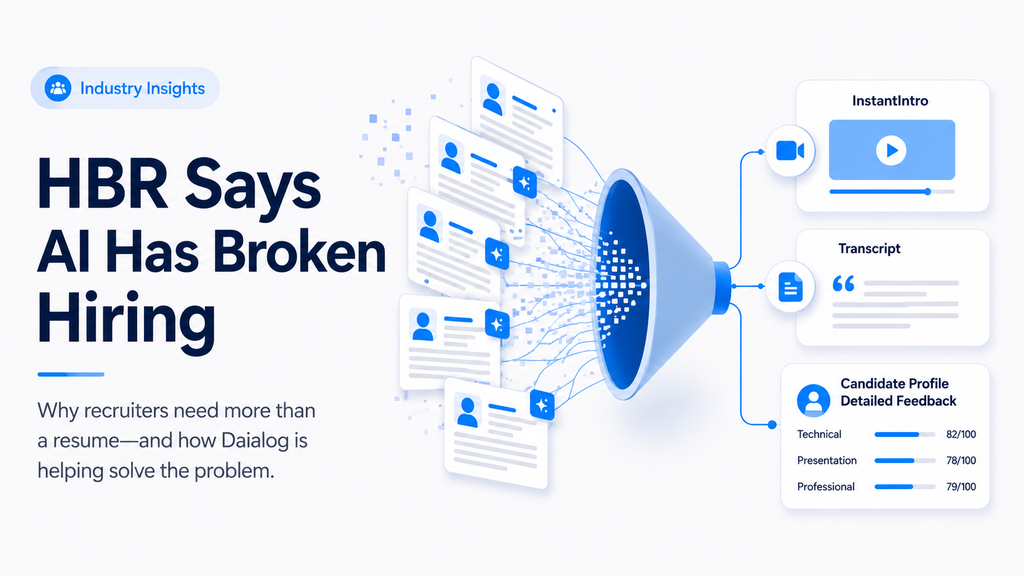
Recruiting has become the part of HR where AI is most at home. Screening, matching and scheduling are high-volume, repetitive jobs, and vendors have built AI into all of them. Yet hiring skilled people is still the problem HR leaders name first. Both things are true at once, and the gap between them is the question worth asking: if the AI is switched on, is hiring actually better?
A note on where we stand: Daialog makes recruiting software, including InstantIntro, so we have a view on this. The figures below are taken from the two reports as published. The analysis and the measures are ours.
What the two reports actually measured
G2, How AI Is Reshaping HR (2026). The report draws on G2's 2026 LMS & HR Software Trends Survey: 1,000 respondents in the U.S., surveyed in February 2026. Respondents worked at companies with more than one employee, held management-level roles or above, and were at least partly responsible for HR software purchases.
- Among organizations with recruiting software, 81% use its AI features. That's the highest AI utilization of any HR category in the survey. Payroll sits at 53% and benefits administration at 48%.
- G2 links recruiting's lead to high-volume work such as candidate screening, matching and scheduling, and links the slower pace in payroll and benefits to accuracy and compliance risk.
Software Advice, 2026 HR's Biggest Challenges. Despite the 2026 title, this report draws on Software Advice's 2025 HR Software Trends Survey: 3,256 respondents in 11 countries, surveyed in April 2025, with the same management-level and purchase-responsibility screening.
- 47% of HR leaders name attracting and hiring skilled professionals as their top challenge, ahead of the need to upskill existing staff.
- The report also says 81% cite recruiting as the hardest area for AI adoption. We explain below why we don't rely on that figure.
Two 81s that mean different things
It's tempting to read the two reports together as "81% use AI in recruiting and 81% struggle with it". That reading doesn't hold.
- G2's figure counts use: organizations with recruiting software that use its AI features. G2 publishes the chart, the category and the sample.
- Software Advice labels its figure as difficulty, in two wordings: the "hardest AI adoption area" and the "biggest AI challenge". It doesn't publish the underlying question.
- Software Advice's three AI figures, 81% for recruiting and 75% each for employee engagement and HR analytics, are identical to G2's AI feature utilization rates for the same three categories, which come from a different survey run about ten months later. From the report alone, we can't confirm what Software Advice's figure measures.
So we don't use Software Advice's 81% as evidence, and we don't add, compare or merge the two. What the evidence supports is narrower: in G2's survey, recruiting is where HR uses AI features most. Software Advice's broader point stands without the number: embedding AI in recruiting needs governance to stay fair and transparent.
Why usage isn't the same as better hiring
Usage numbers rise whenever automation is added, because automation produces activity. Resumes parsed, applicants ranked, messages sent and interviews booked all go up on the day a feature is switched on. None of them says whether the right people were hired, or whether good applicants were seen at all.
Two examples show the gap:
- Faster sorting of the same information. A tool that ranks resumes shrinks the pile quickly, but it ranks on what the resume says. If the resume was a weak signal before, it's a weak signal sorted faster.
- Faster calendars, same decision. Scheduling automation saves real hours. It doesn't change who gets to the interview or how they're judged.
Both can be worth having. Neither is evidence that hiring improved, and neither can answer the 47% problem on its own: finding and hiring skilled people.
Five measures that show whether AI helped
These are outcome measures, not activity counts. Each can be taken from your applicant records and a short review of recent decisions.
- Coverage. The share of applicants who got a real first look, from a person or a structured conversation, rather than being filtered out on keywords. If AI only narrows the funnel faster, coverage stays flat or falls.
- Time to first real contact. Days from application to the first exchange in which the applicant is asked about their own experience. An automated "we received your application" email doesn't count.
- Shortlist agreement. The share of shortlisted candidates the hiring manager chooses to interview. If the AI is surfacing the right people, agreement should rise, and the back-and-forth over shortlists should shrink.
- Explainability. Pick ten recent advance-or-decline decisions. For each, can the recruiter say why in one sentence and point to the evidence? G2 reports that 44% of HR leaders see understanding how AI reaches its recommendations as a barrier. A decision nobody can explain is a decision nobody can check.
- Early outcomes. Retention and the hiring manager's rating of new hires after about 90 days. These lag, but they're the closest most teams get to quality of hire.
Add one candidate-side check: the drop-off rate at each screening step, and whether applicants were told what the step was, who reviews it and when they'll hear back.
Run a before-and-after on one role family
You don't need a data team to find out whether an AI step is working.
- Pick one role family with steady volume, such as customer support or sales development, so the numbers aren't swamped by one unusual search.
- Take a baseline of the five measures over the last eight weeks.
- Change one step, for example the first-round screen, and leave everything else alone.
- Measure the next eight weeks the same way.
- Keep the change only if coverage or shortlist agreement improved and nothing else got worse. If only activity went up, you've bought speed, not better hiring.
When you evaluate vendors, ask them to show the outcome measures their customers track, not just how many applicants their AI processed.
What we built Daialog around
We built InstantIntro around the first and fourth measures, coverage and explainability.
- Every applicant can be heard. In an InstantIntro, each applicant has a short spoken conversation with Daia, Daialog's AI screening agent, which asks the role's questions with follow-ups. Candidates know they're talking with an AI.
- One explained score. Daia assesses each conversation against the role and gives one Match Score with an explanation, so a recruiter can see why a candidate scored as they did.
- People decide. There's no automatic rejection or knockout. A recruiter or hiring manager decides who moves forward.
- Choice of route. Each role can accept an InstantIntro, a resume or either, so applicants who can't do a spoken screen still have a way in.
If you're weighing a conversation against a resume as the first step, our comparison of InstantIntro and resume screening covers the trade-offs. For a wider look at tools that keep people in charge, see AI hiring tools that keep recruiters in control.
Every applicant has a short spoken conversation with Daia, assessed against your role. You decide who moves forward. See how InstantIntro works
The question to keep asking
The reports agree that recruiting is where HR has gone furthest with AI. The useful question isn't whether your team uses it. It's whether more of the right applicants are being heard, sooner, with reasons you can stand behind. If the answer is yes, the AI is earning its place. If only the activity numbers moved, it's time to change the step, not add another feature.