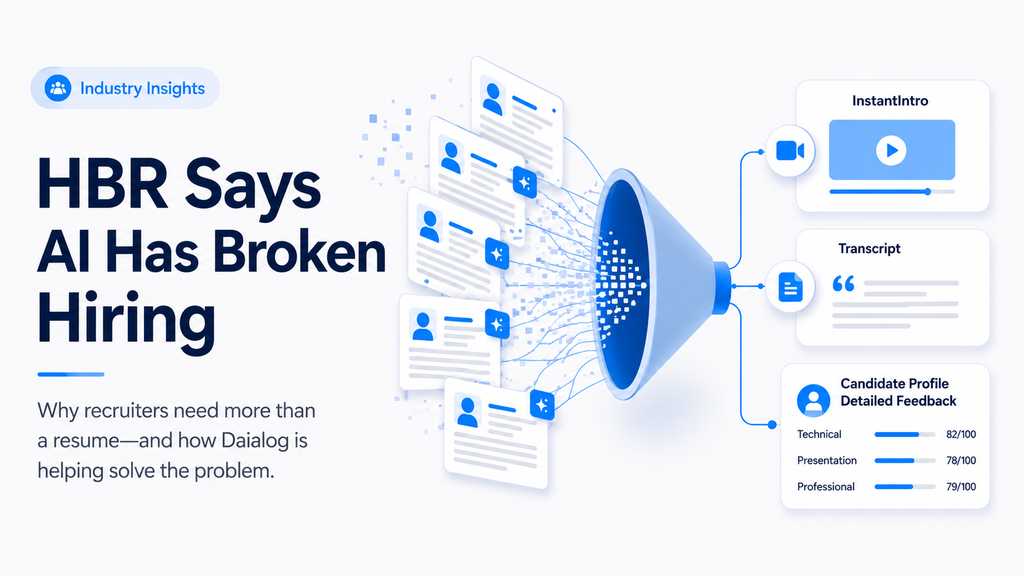
A new piece in Harvard Business Review puts into words something a lot of recruiting leaders have been quietly feeling for months. We think it's worth reading, and worth responding to.
The piece, backed by conversations with 120 talent acquisition leaders and an analysis of over 6,300 recorded screening sessions, lands on a simple but damning conclusion: the early hiring funnel is breaking on both ends. Resumes have lost their signal value. AI has made it trivially easy to generate polished, keyword-optimized applications, and the AI screeners processing them aren't immune either. Meanwhile, live remote interviews are being gamed in real time by tools that overlay scripted responses during video calls. Suspicious behavioral patterns appeared in nearly 60% of first-round sessions for new grad software engineering roles.
The authors' conclusion: companies are systematically selecting for candidates who are best at performing the hiring process, not those best equipped to do the job. We agree. And for many hiring teams, it's already the reality.
What This Means for Hiring Teams Specifically
The HBR piece is written from a broad lens, but the implications hit hiring and recruiting teams particularly hard.
You're managing high application volumes without the luxury of going fully outbound. You're accountable to clients and hiring managers who are losing faith in the pipeline. You're under pressure to move faster, hire better, and do it with the same or fewer resources. And the traditional tools you've relied on (the resume, the structured behavioral screen) are becoming less reliable precisely when you need them most.
One talent leader quoted in the article put it plainly:
I've stopped putting jobs on job boards. Everyone applies to every role with a resume perfectly customized to that role. No point. I'm only doing outbound now.
That's an understandable response. But as the authors point out, it's not a neutral one. Abandoning open applications quietly dismantles one of the few structural mechanisms that allows candidates without elite networks or credentials to be seen at all.
The problem isn't that inbound hiring is broken by nature. It's that the tools most teams use to process inbound applicants were built for a world where a resume was a meaningful signal. That world is gone.
Where Daialog Fits Into This

Daialog is a recruiting OS for in-house TA teams and recruiting firms that combines ATS, CRM, video screening, sourcing, business development, and streamlined recruiting workflows in one platform.
We didn't build Daialog to replace the recruiter. We built it because we believe the earliest layer of the hiring funnel needs to change, not just be automated.
The HBR authors make a distinction that we think matters a lot: the difference between a behavioral interview and an adaptive, reasoning-based one. Behavioral interviews ask predictable questions with predictable frameworks. As the article notes, those are the easiest for AI assistance tools to script in real time. Adaptive interviews, where the conversation shifts and candidates have to defend their thinking on the fly, are much harder to fake.
InstantIntro is built around a similar philosophy. Instead of asking candidates to upload a resume, which increasingly tells you more about their AI prompt skills than their actual fit, we give them structured, role-specific questions to respond to on video. Async, on their own time, with no scheduling friction.
That does a few things the resume can't:
- It surfaces communication and reasoning early. You see how a candidate explains themselves before you've committed any recruiter or hiring manager time to them. The HBR piece describes a product designer named Joanna (sparse resume, regional school, filtered out of over 100 roles) who, in a reasoning-based screen, challenged the underlying business assumption of the question she was asked and proposed a three-tier trade-off. She was hired and ranked among the team's top performers six months later. Roughly one in four candidates in their study followed a similar pattern: outperforming what their resume suggested when given the chance to reason out loud.
- It makes AI-assisted cheating significantly harder. A scripted video response to open-ended, role-specific questions is much easier to detect than a polished PDF. And because the questions are tailored to the role, and not pulled from a standard behavioral bank, the real-time scripting tools the HBR article describes are less effective.
- It keeps the funnel open. Unlike retreating to fully outbound hiring, InstantIntro lets you maintain an inbound process while still getting authentic signal. Candidates who don't have a perfectly formatted resume get a chance to show what they can actually do.
- Blind screening keeps evaluation honest. We know bias enters the process early and often. Blind mode strips name, photo, school, and other identifying details at the screening stage so your team is evaluating reasoning and communication, not pedigree.
The Broader Shift
The HBR authors close with a line we think deserves to be repeated:
When competence becomes easy to simulate, judgment becomes the scarcest hiring signal.
That's the frame we build around. The resume was always a proxy: a shorthand for competence that worked reasonably well when it was hard to fake. It's not hard to fake anymore. The question isn't whether to abandon it entirely, but how to get authentic signal earlier in the process, before expensive recruiter and hiring manager time is on the line.
That's the problem Daialog is built to solve. Not by making screening more automated, but by making it more real.
Read the full HBR article: AI Has Broken Hiring. Here's How to Fix It.
Want to see how InstantIntro works? Book a demo or start a free trial.