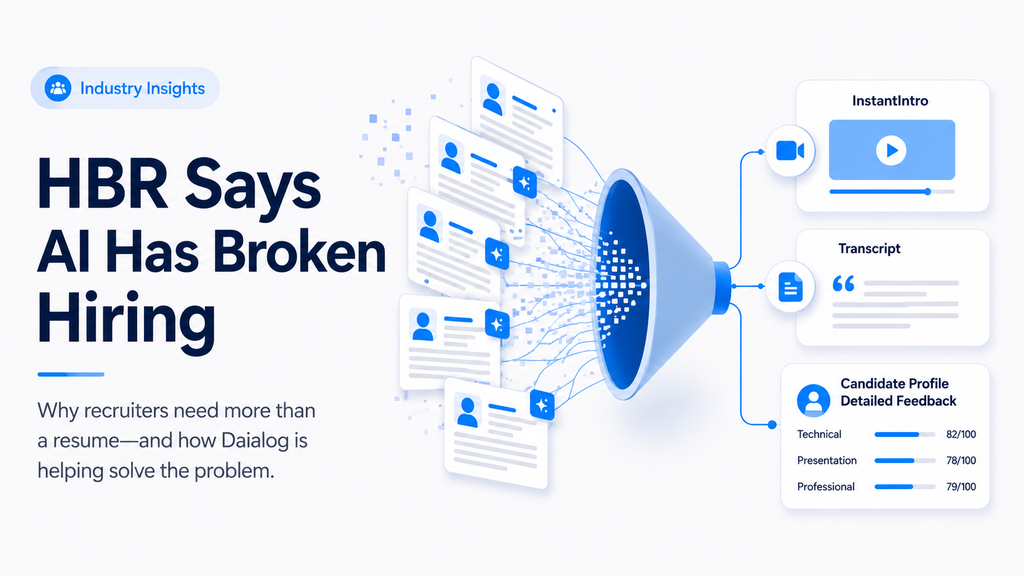
When HR leaders explain what holds back AI, the answer is rarely the AI itself. In G2's 2026 survey, the barrier named most often is data: half of respondents say maintaining high-quality data is the biggest obstacle to adopting AI-powered HR software. In payroll or benefits, that means clean records and connected systems. In hiring, it means something more basic: the information you collect about candidates in the first place.
We make Daialog, a recruiting platform, and our product takes a position on this question. The survey figures below are G2's and Software Advice's. The audit and the examples are ours.
What the reports say about AI barriers
G2's How AI Is Reshaping HR draws on its 2026 LMS & HR Software Trends Survey: 1,000 U.S. respondents in February 2026, all at management level or above and at least partly responsible for HR software purchases. Asked about barriers to adopting AI-powered HR software, they named:
- maintaining high-quality data: 50%;
- data privacy concerns: 46%;
- AI skills on staff: 44%;
- AI transparency, meaning understanding how AI reaches its recommendations: 44%;
- employee resistance: 38%;
- auditing AI algorithms: 30%.
Software Advice's 2026 HR's Biggest Challenges, based on its 2025 survey of 3,256 HR leaders in 11 countries, makes a related point from the governance side: without strict governance, AI in core processes such as recruiting risks bias and poor decisions. Its advice is to audit algorithms, build AI literacy and explain clearly how AI is used.
The two reports reach the same conclusion from different directions: AI adoption in HR is now held back more by inputs, oversight and trust than by the technology.
Why candidate data is a quality problem
Think about what most screening tools read: resumes and application forms. As data, they have three weaknesses.
- They aren't comparable. Every resume answers different questions in a different format. A tool scoring them is comparing documents, and documents vary with writing skill, template and polish as much as with experience.
- They're second-hand. A resume describes the work rather than showing how the person thinks about it. It's easy to make it say the right things.
- They leave the important questions unanswered. Most roles have a few questions that matter more than any keyword, such as how someone handled a difficult customer or why they want this kind of work. Resumes rarely answer them.
Clean pipes don't fix weak inputs. If the first thing your AI reads is inconsistent, everything downstream, from ranking to shortlists, inherits the inconsistency. This is the hiring version of G2's data quality barrier.
Five qualities of good candidate data
Before adding AI to a step, check the information that step will read against five qualities.
- Comparable. Every applicant for a role answers the same core questions, so they can be assessed on the same basis.
- First-hand. The answers are in the candidate's own words, spoken or written, about their own experience.
- Role-specific. The questions come from what the role really needs, agreed with the hiring manager, not from a generic template.
- Explainable. Any score or summary can be traced back to what the candidate actually said, so a person can check it. This is the hiring version of the 44% who find AI transparency a barrier.
- Disclosed and kept in one place. Candidates are told what's collected, why, and whether AI is involved, and the information lives on the candidate's record rather than scattered across inboxes and personal notes.
Run an input audit on one role
You can do this in an afternoon with one open role.
- Pull 20 recent applicants. Note what information you have for each: resume, form answers, call notes, interview feedback.
- Try to compare them on three questions that matter for the role. If you can't answer the same three questions for most of them, your inputs aren't comparable yet.
- Check the decisions. For each applicant who was declined, is the reason written down, and does it rest on evidence or on a guess from the resume?
- Check where interview evidence lives. Are notes and scorecards on the candidate record, or only in an interviewer's head or inbox?
- Check what candidates were told. Did the posting or application say what the screening step involves and whether AI is used?
Fix what the audit turns up before adding more AI. Often the most valuable change is simply asking every applicant the same few questions.
A small example
Two applicants apply for a customer success role. Their resumes are almost interchangeable: similar titles, similar tools, similar phrasing. A resume-ranking tool scores them within a point of each other.
Ask both the same three questions instead: a time they turned around an unhappy customer, how they decide what to escalate, and why they want this role. One gives a specific story with a clear judgment call. The other gives a general answer. The difference was never in the resumes. It only appeared once the input changed.
How Daialog approaches the inputs
Daialog is built to collect comparable, first-hand information early and keep it on one record.
- The same questions for every applicant. In an InstantIntro, each applicant has a short spoken conversation with Daia, Daialog's AI screening agent, which asks the role's questions with follow-ups. Candidates know they're talking with an AI.
- Evidence you can check. Daia assesses each conversation against the role and gives one Match Score with an explanation, so a recruiter can see what the score rests on. People decide who moves forward; there's no automatic rejection.
- Interview evidence on the record. The AI Notetaker joins Google Meet and Microsoft Teams calls (Zoom is coming soon), and writes an English transcript, a summary and an interview scorecard that updates the candidate's profile.
- Optional blind screening hides identifying details until a stage you choose. It's off until you turn it on.
- A route for everyone. Each role can accept an InstantIntro, a resume or either.
For other ways to move beyond the resume, such as skills tests and work samples, see our guide to alternatives to resume screening.
Every applicant has a short spoken conversation with Daia, assessed against your role. You decide who moves forward. See how InstantIntro works
The bottom line
The data quality barrier in G2's survey isn't only an IT problem. In hiring, it starts with the questions you ask and where the answers end up. Make the inputs comparable, first-hand and explainable, and AI has something worth reading. Leave them as they are, and AI will sort weak evidence faster.