A recent piece in Fortune puts a name on something a lot of recruiting leaders have been feeling for months. We think it's worth reading, and worth responding to.
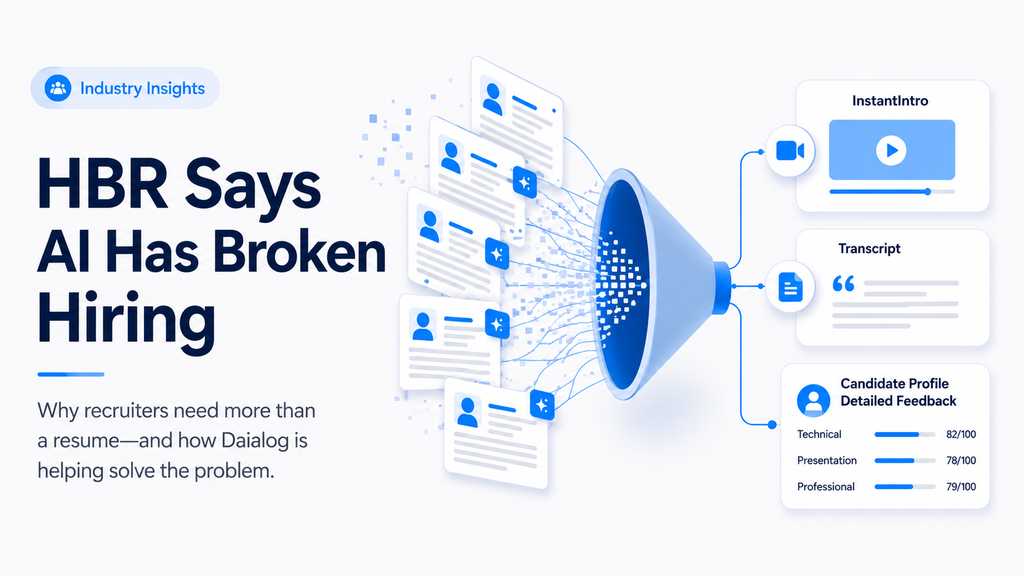
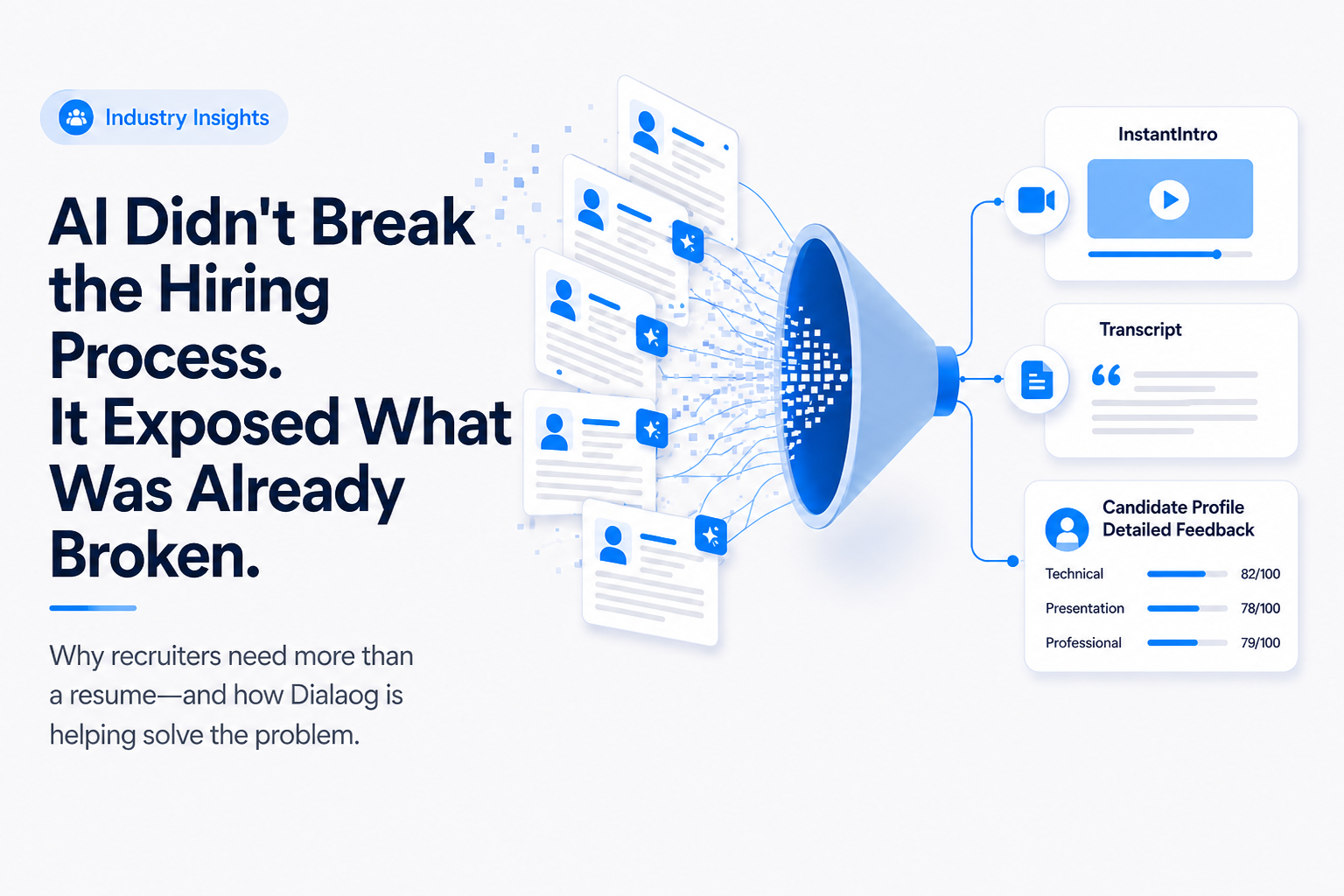
The reporting centers on Greenhouse CEO Daniel Chait's description of an AI hiring doom loop: job seekers, exhausted from shooting résumés into the void and getting ghosted, are turning to low-cost AI tools that blast applications across open roles at scale. Employers, overwhelmed by the resulting surge, deploy their own AI to filter candidates out. Rejected or ignored applicants respond by sending even more automated applications. On Greenhouse alone, live job postings are averaging around 254 applicants each, with applications per recruiter up sharply over the past year. Recruiters can receive hundreds or thousands of applications in a day or two — and because so many are AI-generated, they increasingly start to look the same.
Chait's conclusion: this is the first time both sides of the hiring market are genuinely unhappy at once. We agree. And for many recruiting teams, it's already the operating reality.
What This Means for Hiring Teams Specifically
The Fortune piece is written from a broad market lens, but the implications land hardest on the teams actually running the funnel day to day.
You're managing application volume that keeps climbing without a proportional increase in headcount. You're accountable to clients and hiring managers who are losing confidence that inbound pipelines still produce real candidates. You're under pressure to move faster, hire better, and do it with the same or fewer resources. And the traditional signal you've relied on — the resume as a proxy for interest, effort, and fit — is becoming less reliable precisely when you need it most.
Chait put the dynamic plainly:
Everyone's using their own AI to solve their own problem, but it's making the whole system worse.
That's an accurate description of the loop. Candidates aren't necessarily applying because they're excited about a role. They're applying because the cost of applying has effectively disappeared. Recruiters respond with smarter parsers, better ranking algorithms, and stronger filters. Those tools may help teams process more volume. They don't solve the underlying problem: if the input is weak, a smarter filter doesn't make the input meaningful.
The industry keeps asking AI an increasingly impossible question — which resume is the best? — when the more important question is becoming what should an application actually be? The problem isn't that inbound hiring is broken by nature. It's that most inbound workflows were built for a world where applying took effort, and a resume was a reasonable signal that someone cared. That world is gone.
Where Daialog Fits Into This

Daialog is a recruiting OS for in-house TA teams and recruiting firms, combining ATS, CRM, video screening, sourcing, business development, and recruiting workflows in one platform. Teams that already have an ATS can connect Daialog to use InstantIntro to fix their top of the funnel problem without replacing their current stack.
We didn't build Daialog to replace the recruiter. We built it because we believe the earliest layer of the hiring funnel needs to change, not just be automated.
The doom loop Chait describes won't be solved by adding more automation to a resume-first process. It will be solved by changing what happens at the point of application — by giving candidates a way to demonstrate intent, and giving recruiters something richer to evaluate before they commit time to a screen.
InstantIntro is built around that philosophy. Instead of asking candidates to upload a resume, which increasingly tells you more about their AI prompt skills than their actual fit, we give them structured, role-specific questions to respond to on video. Async, on their own time, with no scheduling friction. They invest a few minutes demonstrating why they're interested, how they communicate, and what makes them a strong fit.
That does a few things the resume can't:
- It restores intent as a signal. Someone willing to auto-apply to 1,000 jobs is far less likely to invest meaningful time in 1,000 thoughtful introductions. A small upfront investment changes the economics of mass applying without closing the funnel to candidates who don't have a perfectly polished resume.
- It surfaces communication early. You see how a candidate explains themselves before you've committed any recruiter or hiring manager time to them. Structured responses give you context the resume no longer reliably provides — how they think, how they communicate, and how they connect their experience to the role.
- It gives AI something useful to work with. Recruiters receive structured responses, role-specific analysis, and AI-generated candidate insights built from actual participation — not keyword-matched PDFs. AI can summarize conversations, surface patterns, and eliminate repetitive work. It can't create strong hiring signals from weak inputs.
- It keeps the funnel open. Unlike retreating to fully outbound hiring, InstantIntro lets you maintain an inbound process while still getting authentic signal. Candidates who might be filtered out on paper alone get a chance to show what they can actually do.
The Broader Shift
Chait closes the loop with a question that gets at the heart of the problem:
Why would I send out automatic thousands of job applications if every single one of them I have to take an interview for?
That's the frame we build around. The resume was always a proxy: a shorthand for interest and competence that worked reasonably well when it was hard to fake and expensive to submit. It's not expensive anymore. The question isn't whether to abandon inbound hiring entirely, but how to get authentic signal earlier in the process — before expensive recruiter and hiring manager time is on the line.
That's the problem Daialog is built to solve. Not by making screening more automated, but by making the application itself the first real conversation. When candidates have a better opportunity to stand out, recruiters spend less time sorting through noise, and AI finally has the information it needs to be genuinely useful.
Read the full Fortune article: Greenhouse CEO Daniel Chait on the AI hiring doom loop
Want to see how InstantIntro works? Book a demo or start a free trial.